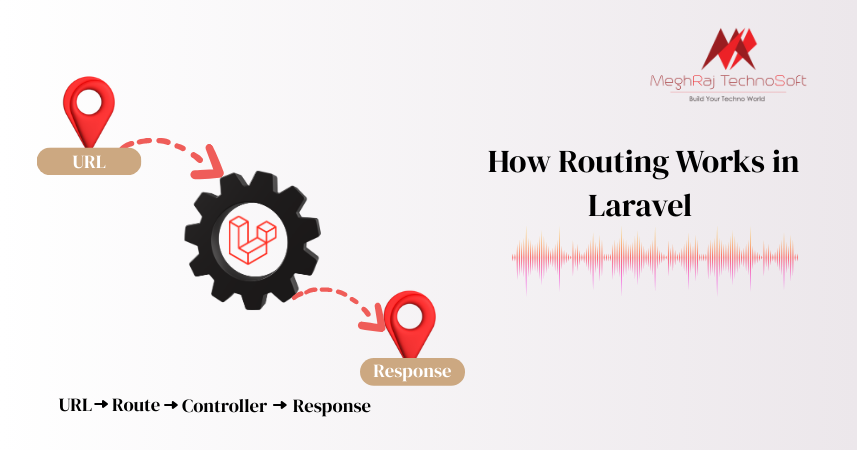
How Routing Works in Laravel (Beginner-Friendly Guide)
At MeghRaj Technosoft, we believe strong developers are built on clear fundamentals—and in Laravel, routing is one of the most important foundations.
Before controllers, middleware, or APIs come into play, every request first passes through routes.
Let’s understand how Laravel routing works, step by step 👇
🔍 What Is a Route in Laravel?
A route tells Laravel:“If someone visits this URL, execute this code.”
You can think of routes as direction boards—they guide incoming requests to the correct logic inside your application.
🔄 Laravel Routing Flow (Only Routes)
1️⃣ User Enters a URL
Example: /about
The browser sends a request to the Laravel application.
2️⃣ Laravel Checks Route Files
Laravel looks for matching routes inside:
- routes/web.php
- routes/api.php
These files act as the entry point for all requests.
3️⃣ Laravel Checks the Request Method
Laravel validates the HTTP method:
GET | POST | PUT | DELETE
|
1 2 3 4 |
Route::get('/about', function () { return 'About Page'; }); |
- GET /about → ✅ Match
- POST /about → ❌ No match
👉 Both URL and method must match.
4️⃣ Laravel Matches the URL
Laravel compares:
- Requested URL
- Defined route URL
If a match is found → continue If no match → 404 | Not Found
5️⃣ Route Parameters Are Processed
|
1 2 3 |
Route::get('/user/{id}', function ($id) { return $id; }); |
Request:
/user/5
Laravel understands:
- {id} = 5
This allows dynamic routing.
6️⃣ First Matching Route Is Executed
Laravel stops at the first matching route, so route order matters.
❌ Incorrect order:
|
1 2 |
Route::get('/user/{id}', ...); Route::get('/user/profile', ...); |
✅ Correct order:
|
1 2 |
Route::get('/user/profile', ...); Route::get('/user/{id}', ...); |
7️⃣ Route Action Runs
The route logic executes and returns a response:
|
1 |
return 'Hello Laravel'; |
8️⃣ Response Is Sent to the Browser
Laravel sends the final output back to the user.
❌ What If No Route Matches?
Laravel responds with:
404 | Not Found
🧠 One-Line Summary
Request → Check Method → Match URL → Run Route → Send Response